

The flow of rainwater racing across pavement and lawns every July is familiar in many neighborhoods. Down it runs—over patios, across driveways, taking with it bits of topsoil, fertilizer, or worse. When the clouds finally drift, what’s left behind? Puddles. Mud. Maybe a soggy patch under the tree. A thousand small headaches that, combined, become a bigger story. Maybe that’s where the journey of stormwater trench landscaping begins: not with a blueprint, but with a simple wish that heavy rains don’t leave a mess behind.
Urban Oasis believes every yard has the potential to handle stormwater in a smarter way. For years, the team has re-imagined outdoor living not just as places for leisure, but as spaces where nature and design collaborate. Tree trenches, living swales, and rain gardens—all these aren’t just aesthetic choices. They’re answers to summer’s thunderous, unwelcome downpours.
In this article, you’ll learn how moisture-loving trees and cleverly engineered trenches can tame seasonal deluges, improve your soil, beautify your space, and quietly protect both your backyard and your city. Sometimes the simplest choices—like planting the right tree in the right trench—are the ones that matter most.
Where rain goes when it falls
Urban yards and small commercial spaces have a recurring struggle when storm clouds gather. Unlike open countryside, where water seeps slowly into the earth, city soils get compacted, surfaces harden, and rain runs along the quickest path downhill. Where does that water go? Too often, straight to storm drains, carrying with it everything loose along the route.
- Runoff increases flood risk in low-lying areas.
- Stormwater can weaken foundations and erode gardens.
- Nutrients and pollutants are swept into rivers and lakes, lowering water quality.
Traditional yards try to “solve” water issues with sloped grading or a few drains, but those solutions are rarely pleasing and often prone to failure. So, a different idea took root: can nature help, if we let it?
Let the land absorb what the sky gives.
Stormwater tree trenches: a quick overview
A stormwater tree trench is about blending functionality with green beauty. Imagine a shallow, stone-filled channel—not a ditch, not a pipe, but an inviting linear rain garden, sometimes lined by trees. These trenches run parallel to pavement, driveways, or even patios. Below the surface, layers of gravel, sand, and engineered soil act as both filter and sponge. Trees, chosen for their water-loving habits, are spaced within the trench or along its edge. As rainfall hits the ground, water flows into the trench, percolating through soil and roots.
- The water is slowed and filtered.
- Roots soak up what they need, releasing cleaner water to the ground below.
- Any surplus—during a true downpour—moves along a perforated pipe, eventually reaching storm sewers or a garden bed.
Instead of a gushing torrent, you get a gentle flow, managed and refined by layers of living and non-living material. The way a series of connected tree pits with gravel and pipes works together to reduce flooding makes stormwater tree trenches an increasingly popular choice for both residential and commercial properties.
How trenches planted with trees manage summer rains
Imagine July brings a series of cloudbursts—hard and relentless. Water sheets down your roof and rushes off your patio, pooling along the lowest edge of your garden. But instead of flooding your flowerbeds or washing out your mulch, the rain is channeled into a trench lined with young red maples and black gums. Here’s what happens:
- Collection: The trench intercepts water at the surface, catching flow before it runs elsewhere.
- Infiltration: Gravel and sandy loam beneath the trees allow rainfall to sink in quickly—no puddles, no mess.
- Uptake: Trees like willows and swamp white oaks thrive on the extra moisture, pulling nutrients and water up through active root systems.
- Filtration: As water moves through the soil, pollutants and sediments are removed. (This process is very effective according to information on how roots and soil improve water quality.)
- Overflow management: In especially heavy storms, any excess filters through an underdrain—often a perforated pipe—directing cleaner water toward sewers or safe discharge zones.
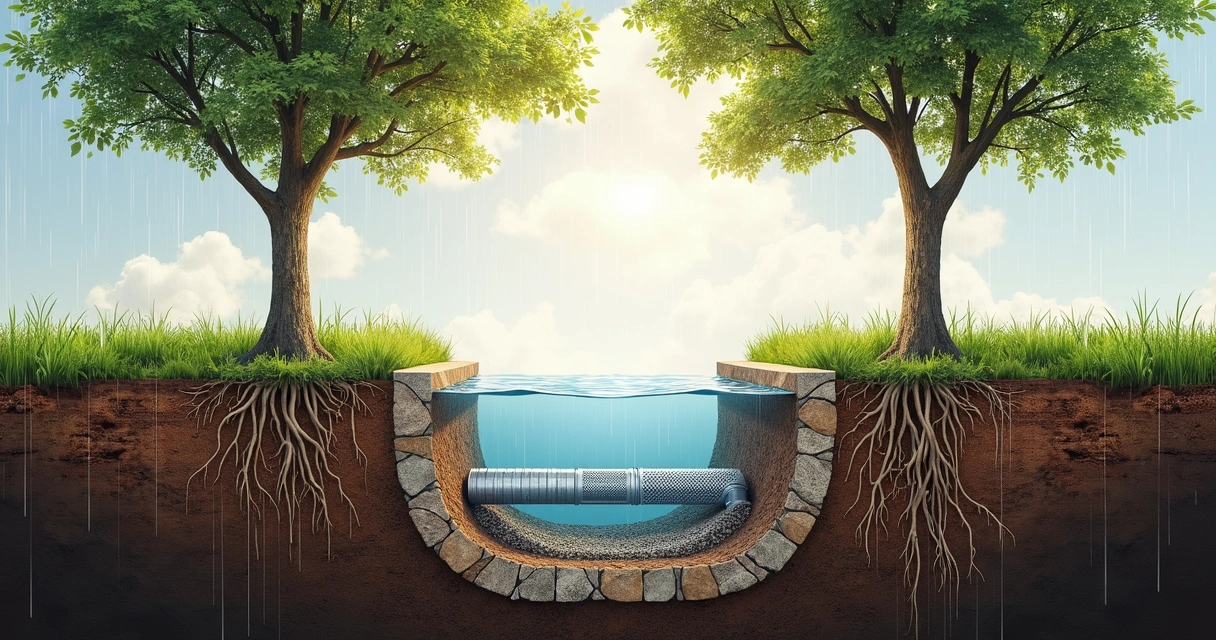 In a matter of hours, what would have been standing water is pulled into a living system—and the landscape remains lush, never boggy or waterlogged for long. This system mimics natural floodplains and forest edges, where water rises and falls with the season, feeding robust, deep-rooted plants.
Trees drink first, and the land thanks them later.
How tree trenches improve your yard and beyond
Of course, the most obvious gain is drier, healthier ground where you want it. But the payoffs go further. The benefits of tree trenches extend well beyond water management, shaping local microclimates and even the wider environment.
- Improved tree health: Trees in trenches receive consistent access to water and nutrients, especially in dry spells. Their roots grow wide and deep, strengthening against wind and drought, as explained on guides about trench design and soil choices.
- More shade and cooling: The new canopy cools air through shade and evaporation, helping to soften heat waves.
- Flood and erosion reduction: By managing rainfall right where it falls, trenches decrease flash flooding and prevent soil from washing away.
- Water quality protection: Soil and root systems filter out pollutants—oils, fertilizers, and sediments—before they seep downstream. Studies show measurable water improvements in neighborhoods using these methods.
- Wildlife habitat: Moisture-loving trees bring birds and pollinators, making your yard hum with life.
- Beauty and real estate value: Lush, green swales and tree lines are a subtle, but powerful, selling point—especially when paired with features like decks, patios, and pools, all expertly integrated by teams like Urban Oasis. Read more in ideas for low-maintenance but high-impact landscaping.
A richer landscape is a quieter mind during a summer storm.
Anatomy of a stormwater tree trench
If you peer beneath the mulch and root, there’s a clever structure. Trenches can be customized to suit small yards, urban sidewalks, or sprawling commercial courtyards, but most contain common elements:
- Surface mulch: Retains moisture, discourages weeds, and keeps the base cool.
- Engineered soil: A mix that drains well but holds water—often sandier and less compacted than the rest of your yard.
- Structural support: Sometimes, soil cells or structural soils are used to prevent settling around roots and hardscape. You can read about soil cell innovations at resources such as guides for tree trench improvement.
- Aggregate base (gravel or crushed stone): This keeps water moving and gives roots air, not just compacted clay.
- Underdrain system: A perforated, sometimes slotted, pipe laid near the bottom allows overflow to flow off safely if the ground can’t soak it up fast enough.
In a sense, it’s both a garden bed and a living piece of green infrastructure—something that works with both storms and sunlight. Sizes vary, from a trench running the length of a driveway, to a compact bioswale set between two buildings.
 Choosing trees that thrive in wet trenches
 Choosing trees that thrive in wet trenches
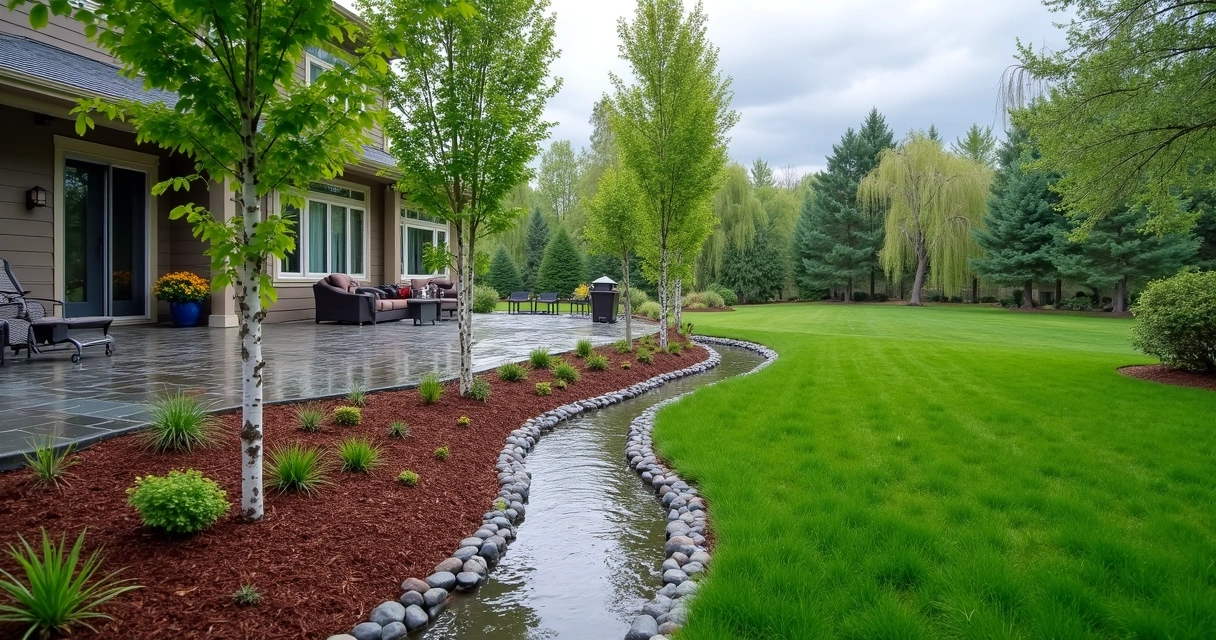
Not all trees want wet feet. Some species will sulk, others will thrive. Picking the right trees means picking those that love—or at least happily tolerate—seasonally wet soil. The secret, according to recent research on tree selection for bioswales, is to choose local or native varieties whenever possible.
- Swamp white oak (*Quercus bicolor*)
- Red maple (*Acer rubrum*)
- River birch (*Betula nigra*)
- Bald cypress (*Taxodium distichum*)
- Willow species (*Salix* spp.)
- Black gum (*Nyssa sylvatica*)
- Serviceberry (*Amelanchier canadensis*)
- Dogwood (*Cornus* spp.)
Native trees work double duty: they adapt better to your microclimate, and support wildlife already used to their shelter and fruit. For regions with wet summers and heavy July downpours, species like river birch and willows almost seem to relish the saturated trench, pushing roots wide and high.
Choose trees that don’t just survive the storm, but grow stronger because of it.
For more inspiration, check out suggestions for beautiful, sustainable Texas yards, where plant selection is both science and art.
Designing your trench: location, size, and style
No two backyards are quite the same, and honestly, what works for your neighbor’s side yard might flop for you. That’s part of what Urban Oasis values as well—every space tells its own story. When considering a rain-catching trench, a few questions make all the difference:
- Where does runoff naturally flow after a rainstorm?
- How much roof or pavement drains into that low spot?
- Is there room for a linear feature, or will a curved shape nestle better into planting beds?
- Will roots eventually clash with any pipes, driveways, or basement walls?
After these basics, consider trench width and depth. A typical yard trench for stormwater with medium-sized trees might be 2–4 feet wide and 2–3 feet deep, allowing roots to expand, but not so deep the water vanishes before trees can use it.
For most homes, it’s also about style. Should the trench be hidden, outlined with ground covers, or celebrated with bold river stones and sculptural trees? Urban Oasis has often included decks and patios alongside trenches, blurring the line between lush garden beds and purposeful design. There are plenty of ideas in our landscaping guide to techniques and benefits for those curious about mixing function and flair.
Integrating with patios, decks, and pools
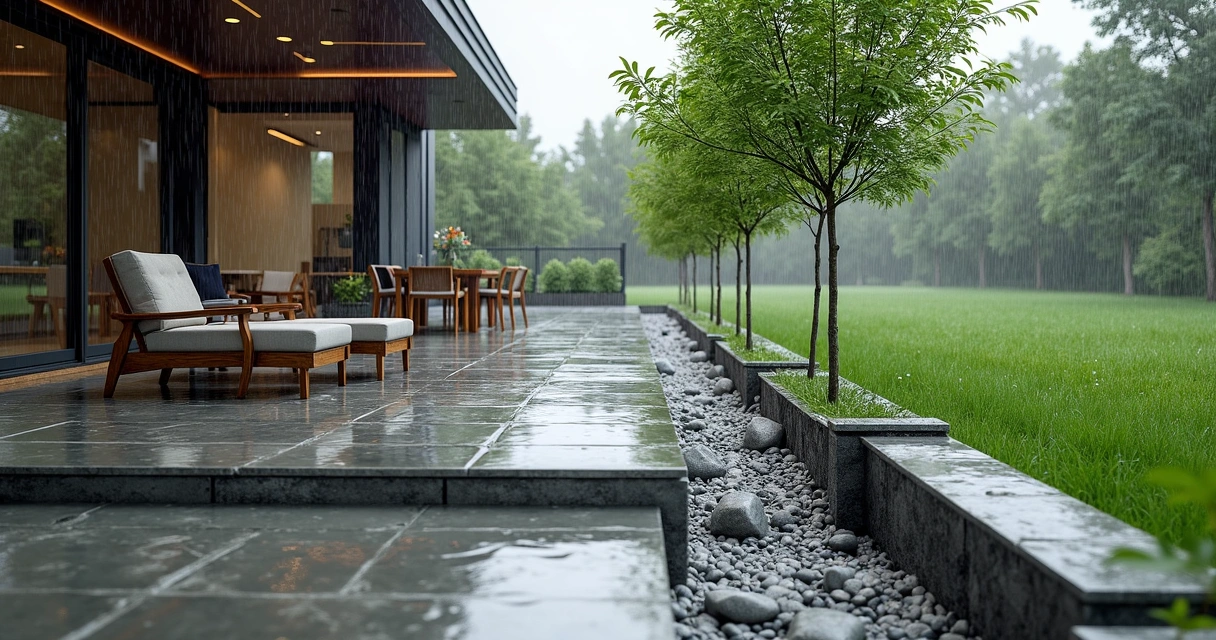
Stormwater management features don’t have to stand alone. Many homeowners are surprised at how easily a tree trench becomes part of a backyard retreat. A narrow swale running beside a sun deck, a row of dogwoods dividing the grill from the playground, or a green trench bordering a pool—these aren’t just utility choices.
- They soften the hard lines of pavement.
- They provide dappled shade where you relax or entertain.
- They buffer the noise of heavy rain, turning downpours into something less urgent, more natural.
Maintenance: keeping your system strong
 Maintenance: keeping your system strong
One thing that makes some homeowners hesitate is the question of upkeep. Will you need to babysit this system after every summer storm? The reality is, with thoughtful design, stormwater trenches are surprisingly forgiving. Routine tasks mostly involve what you’d do anyway in a well-tended yard.
- Annual tree pruning: Keep canopy balanced and allow light to lower plants. Remove any dead wood.
- Add or replace mulch: Carry out each spring to hold moisture and suppress weeds.
- Check inlets and outlets: After especially heavy rains, clear away debris or leaves. Make sure water can move freely.
- Inspect the underdrain (once or twice a year): Lift the access cover if you have one and flush any silt that’s built up in the pipe.
- Weed and monitor plants: It’s normal for volunteer seedlings or weeds to show up; pull them as needed, and replant gaps with ground cover or perennials.
- Replenish gravel if needed: Over time, traffic or roots might shift stones. It’s rare but easy to reset.
For most families, especially those using native trees and regional perennials, a good trench system quickly blends into the rhythm of ordinary yard work. It’s less like a high-maintenance aquarium, more like a rock garden with a few special requests.
If you want to learn how to create a yard that gives back more and demands less, there are practical tips in lawn and gardening resources from Urban Oasis.
What you need to consider: costs, timelines, and practical steps
It’s natural to wonder if the investment lines up with the outcome. Installing a stormwater tree trench isn’t as cheap as tossing a few bags of mulch down, but it’s far from out of reach for most urban or suburban homes, especially weighed against the risk of flood repairs or constant landscape erosion. Average costs fluctuate, partly because each yard is unique, but there are some standard ingredients in the calculation:
- Excavation: Small trenches may be dug by hand; larger jobs use machinery.
- Soil and gravel: Clean, free-draining materials ensure the system works for years.
- Trees and plants: Established saplings have higher up-front costs than small whips, but fill in quickly. Native stock may cost a little more—worth it, in longevity.
- Drainage pipe and outlets: Standard, but not always needed for the smallest jobs.
- Mulch and lining: Keeps the setup tidy, healthy, and low maintenance.
- Labor: DIY can keep things cheaper, but trained hands—such as those from Urban Oasis—guarantee not just a beautiful result, but a reliable one.
Other factors influence price: slope, soil type, tree variety, number of access points, and integration with existing landscape design. On average, small residential trenches land in the same ballpark as premium garden beds or a quality patio expansion.
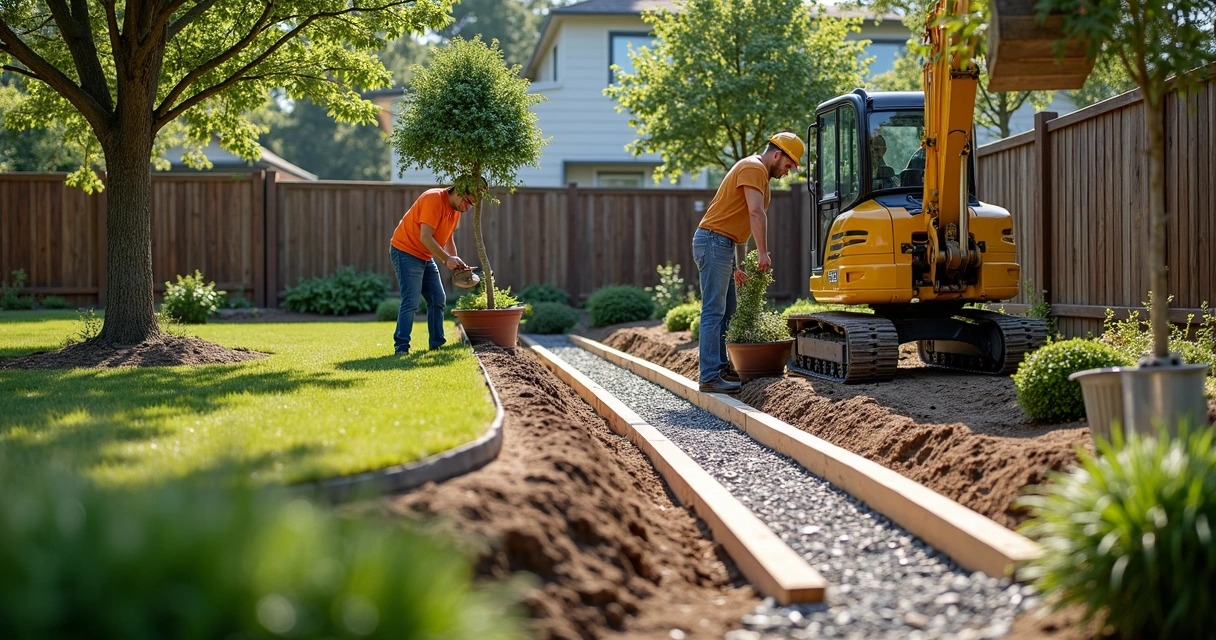 A well-built trench is an investment you see every storm—not one you hope you never need.
Some common myths and slight hesitations
When talking with neighbors, friends, or even some local landscape folks, a few themes pop up.
- “Won’t my backyard be soggy and full of mosquitoes?” Not if designed right. Good trenches drain fast, and standing water vanishes within hours.
- “Aren’t these just for big cities?” No—tree trenches scale perfectly to suburban, even rural yards, and can do wonders on small lots.
- “Do they look out of place?” Not at all. Done well, they blend right in; most visitors won’t even realize the trench doubles as a stormwater filter.
- “Are they expensive to keep up?” Maintenance is mostly seasonal. Once plants mature, the work is less than many other garden features.
If you’re still on the fence, reading through some landscaping examples and talking with experienced teams like Urban Oasis might help. Sometimes it takes seeing a finished yard—healthy, vibrant, and ready for rain—before the doubts disappear.
Making your yard smarter by letting nature lead
There’s a kind of quiet comfort in knowing your backyard can greet the next summer’s storm and not blink. Roots pull in water, stones hold it, and the overflow seeps slowly. A few steps toward smarter landscaping pay themselves back—fewer muddy footprints, happier trees, a yard that looks beautiful even after days of thunder.
Urban Oasis believes that design isn’t just about the space itself, but about how each decision interacts with the world around it. A stormwater trench isn’t flashy, but in the hands of craftsmen who care about both beauty and sustainability, it becomes much more than the sum of its parts.
Let the rain come. Your yard is ready.
Interested in learning how your yard could benefit from a stormwater tree trench? Take the first step with Urban Oasis—find out what’s possible, and create a space where design and nature work together, even on the wettest July day.
Frequently asked questions about stormwater tree trenches
What is a stormwater tree trench?
A stormwater tree trench is a shallow, excavated channel filled with gravel, engineered soil, and mulch, designed to intercept and filter runoff water. Moisture-loving trees are planted along or within the trench, and as rain falls, the system slows, soaks, and filters water through layers of soil and stone. This reduces flooding, improves water quality, and keeps landscapes healthier. The setup often includes an underdrain—a pipe at the bottom—that moves extra water away safely during the heaviest rains.
How do I install a tree trench?
First, identify where water collects or flows after heavy rain. Excavate a shallow trench along that path, typically 2–4 feet wide and about 2–3 feet deep for a residential yard. Line the bottom with gravel, followed by a layer of engineered soil or sand that drains well. Install a perforated underdrain pipe if necessary. Plant moisture-loving trees like red maple or river birch, spacing them to allow room for roots to spread. Finish with a thick layer of mulch. Check water flow after a storm to ensure the trench works well and adjust as needed.
Is stormwater trench landscaping worth it?
Most people find it worthwhile, particularly in areas prone to summer downpours or drainage problems. The upfront cost is usually balanced by less puddling and erosion, reduced flood risk, and much easier yard maintenance after storms. Many also appreciate the added tree canopy for shade and the increase in property value and curb appeal. The real test comes after the first big rain—yards with these features typically stay drier, greener, and more resilient.
How much does a tree trench cost?
Costs depend on trench size, tree variety, soil amendments, and labor. For most homes, expect costs similar to installing a medium-sized garden bed or patio. Small DIY installations may run only a few hundred dollars in materials, while more complex, professionally designed trenches with multiple trees and underdrain systems might cost several thousand dollars. Ongoing maintenance typically involves annual pruning, mulching, and an occasional gravel top-up.
What trees work best for trenches?
Trees that love periodic wet soil are your best picks. Good candidates include swamp white oak, red maple, river birch, willow, bald cypress, black gum, serviceberry, and dogwood. Whenever possible, plant varieties native to your region. Native trees adapt better, resist pests, and support local wildlife—all while thriving in the moist, well-drained trench environment.